

The most important idea in AI isn’t a better model.
It's the institutional sovereignty : Notes from Palantir report
AI model providers have a structural incentive to migrate as much intelligence from enterprises into their model weights—the encoded intelligence of these models—as possible. Doing so allows them to lease your insights to competitors, maximize token usage, rent-seek on your high-margin workflows, or in the most extreme case: completely replace you.
As the financial pressure to grow revenue mounts, model providers have already begun directly competing with their enterprise partners.
If your incentives were aligned with model providers, why do they charge per token and not as a proportion of the value they help you create?
Every few months, the AI industry finds a new obsession. Last year it was prompt engineering. Then came agents. Then reasoning models. Today, much of the conversation still revolves around who has the smartest frontier model: OpenAI, Anthropic, Google, Meta, or whoever releases the next impressive benchmark.
Palantir’s report, Institutional Sovereignty in the Age of AI*, deliberately moves away from that debate. Instead of asking which model is better, it asks a more strategic question: how can an organization ensure that AI compounds its own competitive advantage instead of somebody else’s?
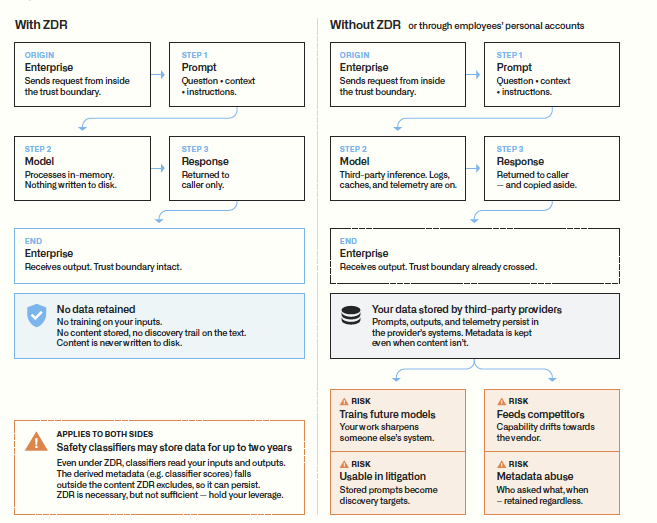
The central argument is simple.

The companies that win in the AI era will not necessarily be the ones that get access to the smartest model first. They will be the institutions that retain ownership of their knowledge, preserve their ability to switch technologies, and build systems where every AI interaction strengthens the institution itself.
Palantir calls this institutional sovereignty.
The enterprise conversation is focused on the wrong layer
Most enterprise AI discussions begin with model selection. Should we use GPT? Should we standardize on Claude? Should we deploy Gemini internally? Should we self-host Llama or Mistral? These are valid engineering questions, but they are not the most important strategic questions.
Models are improving at extraordinary speed. A capability advantage that lasts a few months is increasingly rare. Even the largest AI labs keep leapfrogging one another. A company that builds its entire AI strategy around one model provider may enjoy short-term convenience, but it also creates a dependency that can become expensive, risky and strategically limiting.
The Palantir report* argues that organizations should focus on what remains uniquely theirs: their decisions, workflows, operating knowledge, permissions, context and institutional memory. Those assets compound over years. Model leadership may change every few quarters.
Here are my key (15) takeaways from the report.
Stop asking “Which AI model should we use?” Start asking “What part of our business should we own?”
Institutional Sovereignty is the report’s central idea: AI should compound your organization’s advantage, not your vendor’s.
The future belongs to organizations that own their context, not necessarily the smartest model.
Models will become commodities. The architecture around them will become the competitive advantage.
Model liquidity should be a board-level design principle. Never get locked into a single AI provider.
Keep reading with a 7-day free trial
Subscribe to Ashish Sinha / NextBigWhat to keep reading this post and get 7 days of free access to the full post archives.