Why Kimi K3 is the enterprise AI conversation you can’t ignore

Open weights. Frontier performance. 1 million tokens of context. And a price tag that makes the incumbents sweat.

Idea 01 of 09

Idea 01 of 09

Introduction

All ideas

All ideas

  1. 01Introduction
  2. 02The Specs Are Absurd (In a Good Way)
  3. 03Benchmarks: Trading Blows at the Frontier
  4. 04The Demo That Should Worry Every CTO
  5. 05Pricing: The Incumbents’ Margin Problem
  6. 06Enterprise AI Sovereignty: The Conversation K3 Forces
  7. 07The Bigger Picture: Open Source Just Caught Up
  8. 08What to Watch Next
  9. 09Bottom Line

Introduction

If you are an enterprise AI leader, July 16, 2026, is a date worth circling. That is when Moonshot AI dropped Kimi K3 – a 2.8-trillion-parameter, open-weight model that does not just close the gap with proprietary heavyweights like Claude Fable 5 and GPT-5.6 Sol. In several areas, it erases it entirely.

Here is why this matters for your organization – and why the conversation around AI sovereignty, vendor lock-in, and total cost of ownership just got a lot more interesting.


The Specs Are Absurd (In a Good Way)

Let us get the numbers out of the way:

  • 2.8 trillion parameters – the largest open-source model ever released, roughly 75% bigger than DeepSeek V4 Pro’s 1.6T.
  • 1 million token context window – that is about 750,000 words, or roughly three copies of War and Peace, in a single prompt. No compression tricks, no “context management” workarounds. Just raw, sustained coherence.
  • Native vision – it reads screenshots, diagrams, and UI mockups as naturally as text.
  • Always-on reasoning – K3 does not have a “dumb mode.” Thinking is baked in.

The architecture is genuinely novel: Kimi Delta Attention (KDA) and Attention Residuals allow the model to scale attention efficiently across extreme sequence lengths and depth, while a Stable LatentMoE design activates just 16 of 896 experts per forward pass. The result? Roughly 2.5x better scaling efficiency than its predecessor, K2.

Translation: Moonshot figured out how to make a 3-trillion-class model train and infer without melting the data center.

Kimi K3 architecture diagram showing Stable LatentMoE, KDA modules, Attention Residuals operations, and Block Attention Residuals backbone:

Kimi K3 Is Behind Only Fable 5 And GPT 5.6 Sol In Internal Evaluations, Says Moonshot AI


Benchmarks: Trading Blows at the Frontier

On GDPval-AA v2 – a real-world task benchmark spanning 44 occupations and 9 industries – K3 scored 1,687, placing third behind only Claude Fable 5 Max and GPT-5.6 Sol Max, and ahead of Claude Opus 4.8.

GDPval-AA v2 leaderboard showing Kimi K3 in 3rd place:

Moonshot AI's Kimi K3 Drops 2.8 Trillion Parameters to Beat OpenAI and Anthropic | AlphaSignal

On AA-Briefcase, a private agentic benchmark for long-horizon knowledge work, it took second place with 1,527 – beating GPT-5.6 Sol Max and trailing only Fable 5 Max.

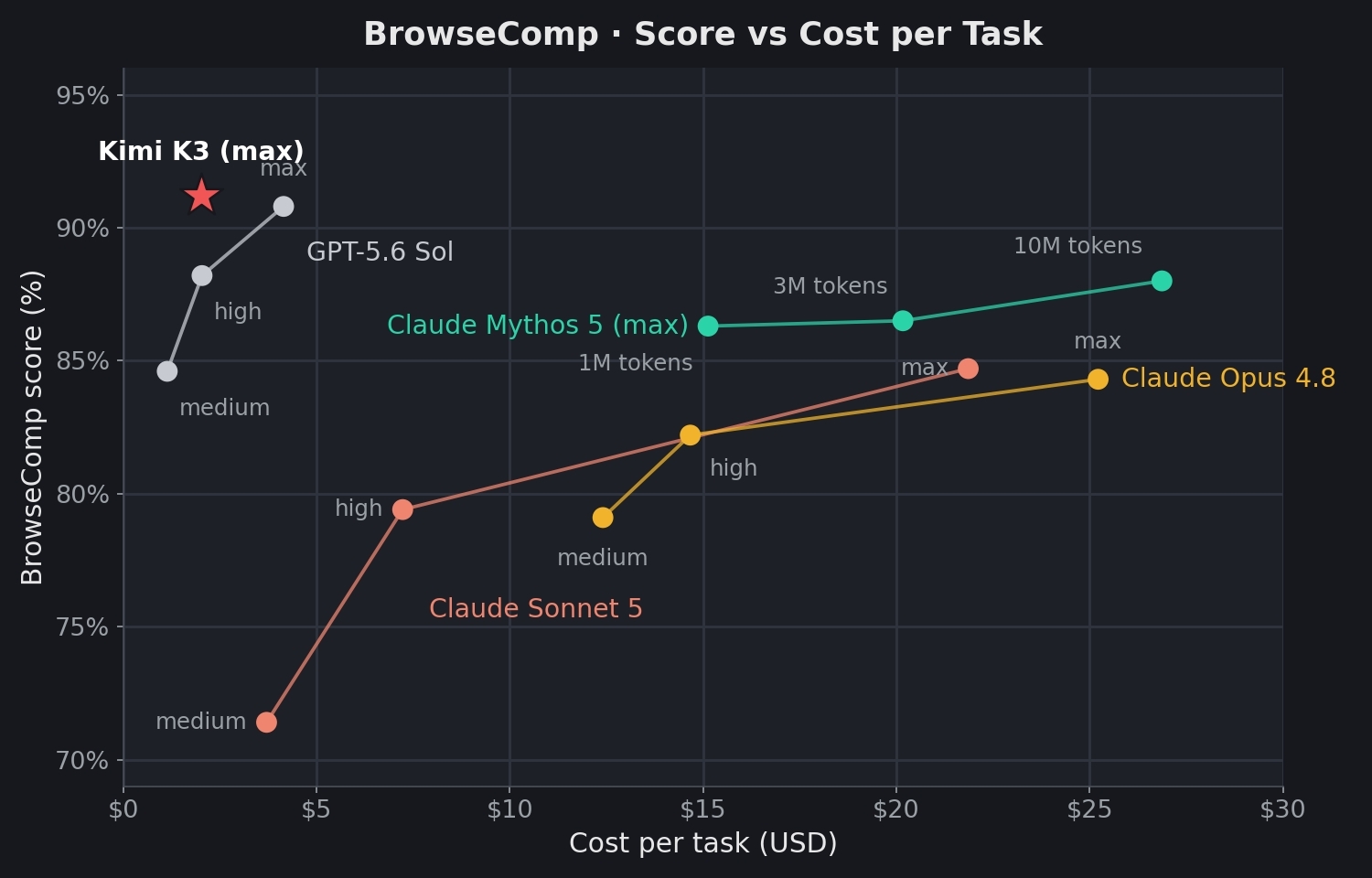
But here is where it gets wild: on BrowseComp, a brutal test of long-horizon information seeking, K3 hit 91.2 – state of the art. And on Arena.AI‘s Frontend Code Arena, it claimed #1 with 1,679 points, outpacing both Fable 5 and GPT-5.6 Sol.

BrowseComp score vs cost per task, showing Kimi K3 (max) at state-of-the-art performance with lower cost:
Kimi K3 Tech Blog: Open Frontier Intelligence

The model did not just compete. It won categories that matter to enterprises: spreadsheets, automation, frontend engineering, and deep research.

Coding benchmarks across DeepSWE, Terminal Bench 2.1, FrontierSWE, Program Bench, Kimi Code Bench 2.0, and SWE Marathon:

Kimi K3 Beats Fable 5, GPT 5.6 On Some Benchmarks In Frontier-Level PerformanceKimi K3 Max Is Here: Moonshot's 2.8-Trillion-Parameter Flagship Just Changed the Frontier Conversation | by Krishna Kumar | Jul, 2026 | Medium

Selected wins and near-misses across Program Bench, SWE Marathon, Automation Bench, BrowseComp, OmniDocBench, Terminal Bench 2.1, and FrontierSWE:


Kimi K3 Is Live: Pricing, Benchmarks, and the Wait for Open Source


The Demo That Should Worry Every CTO

Moonshot showed something that goes way beyond benchmark scores: K3 designed a chip to run a nano-scale version of itself.

Over 48 hours of fully autonomous agent operation, it completed the entire pipeline – architectural design, optimization, verification – using open-source EDA tools. The result? A 4mm2 chip achieving timing convergence at 100 MHz, capable of decoding 8,700+ tokens per second in simulation.

This is not a product. It is a signal. The model sustained coherent, multi-step technical work for two days straight, iterating through failures without human hand-holding. That is not a copilot. That is an autonomous technical workforce.

Another case study: K3 reproduced a complex computational astrophysics calculation (the universal I-Love-Q relation) in about two hours – work that typically takes a senior researcher one to two weeks – by reading and cross-validating 20+ papers and building a complete numerical pipeline.

K3 also built MiniTriton, a compact Triton-like compiler from scratch, with its own tile-level IR layer over MLIR, optimization passes, and a PTX code-generation pipeline. On supported roofline benchmarks, MiniTriton delivers performance on par with or better than Triton and torch.compile.

And in video editing, K3 edited its own teaser from 56 source clips, handling clip selection, motion-matched cuts, frame-accurate beat synchronization, audio processing, and multiple rounds of revision.


Pricing: The Incumbents’ Margin Problem

K3’s API pricing is aggressive:

  • $0.30/MTok cached input
  • $3.00/MTok non-cached input
  • $15.00/MTok output

That is roughly 70% cheaper than Claude Fable 5’s reported $50/MTok output pricing. Even by Chinese standards, K3 is premium-priced – but against Western frontier models, it is a bargain. And critically, full model weights drop on July 27, 2026.

That means enterprises can fine-tune, self-host, and build proprietary systems on a 2.8T-parameter frontier model without writing a single API check to OpenAI or Anthropic.

Kimi K3 at launch – key specs at a glance:

Kimi K3 Is Live: Pricing, Benchmarks, and the Wait for Open Source


Enterprise AI Sovereignty: The Conversation K3 Forces

Let us talk about the thing every CISO and compliance officer is actually worried about: who owns your AI stack?

For the past three years, “enterprise AI” has largely meant “renting intelligence from California labs.” Your data goes in. Their model gets smarter. You get a bill. Rinse, repeat.

K3 changes the math in three specific ways:

1. Data Sovereignty Becomes Actionable

With open weights, you can run this model on-prem, in a private cloud, or in a sovereign region. Your proprietary code, customer data, and internal documents never leave your infrastructure. In an era where Satya Nadella has openly warned that private AI models may absorb customer data and become competitors, that is not paranoia – it is architecture.

2. Vendor Lock-In Loses Its Grip

The Kimi API is OpenAI SDK-compatible. Switching costs just collapsed. If you have already built on OpenAI or Anthropic toolchains, K3 drops in with minimal refactoring. And because the weights are open, you are not betting the company on Moonshot’s continued goodwill or pricing discipline.

3. Total Cost of Ownership Gets Real

Yes, running a 2.8T model requires serious GPU infrastructure – Moonshot recommends supernode configs of 64+ accelerators for optimal inference. But for large enterprises already spending seven or eight figures annually on API tokens, the CapEx/OpEx trade-off starts looking very different when the alternative is perpetual rental at frontier-model prices.

Moonshot’s own Mooncake disaggregated inference architecture (which won Best Paper at FAST 2025) is specifically designed to make extreme-scale inference practical and cost-efficient. This is not a “here is the model, good luck” release. It is a complete serving stack.


The Bigger Picture: Open Source Just Caught Up

For years, the enterprise AI narrative was: “Open source is six months behind.” That lag was acceptable for side projects, but not for mission-critical deployments.

K3 obliterates that assumption. As one prominent AI commentator put it: “Open source is no longer lagging six months behind Western closed-source models. Read that again, and think about what it all means.”

If the performance gap is functionally closed, the remaining differentiators become price, control, and sovereignty – all areas where open weights have a structural advantage.

Moonshot itself is now valued at over $20 billion (with reports of a new round at $31.5B), with annual recurring revenue exceeding $200 million. This is not a research curiosity. It is a commercial force backed by Alibaba, Tencent, and Hongshan Capital, with real enterprise traction: Cursor used Kimi to build Composer 2. DoorDash delegates lower-level work to Kimi K2.6. Thinking Machines used Kimi K2.5 for post-training data generation.

Open frontier model size over time, July 2025 to July 2026, showing Kimi K3 at 2.8T leading the pack:

AINews] Kimi K3 2.8T-A50B: the largest open model ever released; Opus 4.8-class at Sonnet 5 pricing


What to Watch Next

  • July 27, 2026: Full weights release. The real stress-testing begins.
  • Independent verification: Moonshot’s benchmarks are impressive, but enterprise buyers should wait for third-party validation on their specific workloads.
  • Inference economics: Can Moonshot’s Mooncake architecture and KDA-enabled prefix caching actually deliver cost-competitive serving at 2.8T parameters? Early signs are promising – the official API claims >90% cache hit rates on coding workloads.
  • Regulatory response: The U.S. has already imposed temporary export controls on frontier models like Fable and Mythos. K3’s open release will intensify debates about whether open-weight frontier AI should face similar restrictions.

Bottom Line

Kimi K3 is not just another model release. It is a recalibration of the enterprise AI market.

For the first time, organizations can access frontier-level intelligence – reasoning, coding, multimodal understanding, million-token context – without surrendering data sovereignty or signing indefinite checks to closed labs. The performance gap is gone. The pricing gap is massive. And the weights are about to be yours.

If your enterprise AI strategy still assumes that “frontier” equals “proprietary,” it is time to update the deck.

Showing Introduction, idea 1 of 9.