On GDPval-AA v2 – a real-world task benchmark spanning 44 occupations and 9 industries – K3 scored 1,687, placing third behind only Claude Fable 5 Max and GPT-5.6 Sol Max, and ahead of Claude Opus 4.8.
GDPval-AA v2 leaderboard showing Kimi K3 in 3rd place:

On AA-Briefcase, a private agentic benchmark for long-horizon knowledge work, it took second place with 1,527 – beating GPT-5.6 Sol Max and trailing only Fable 5 Max.
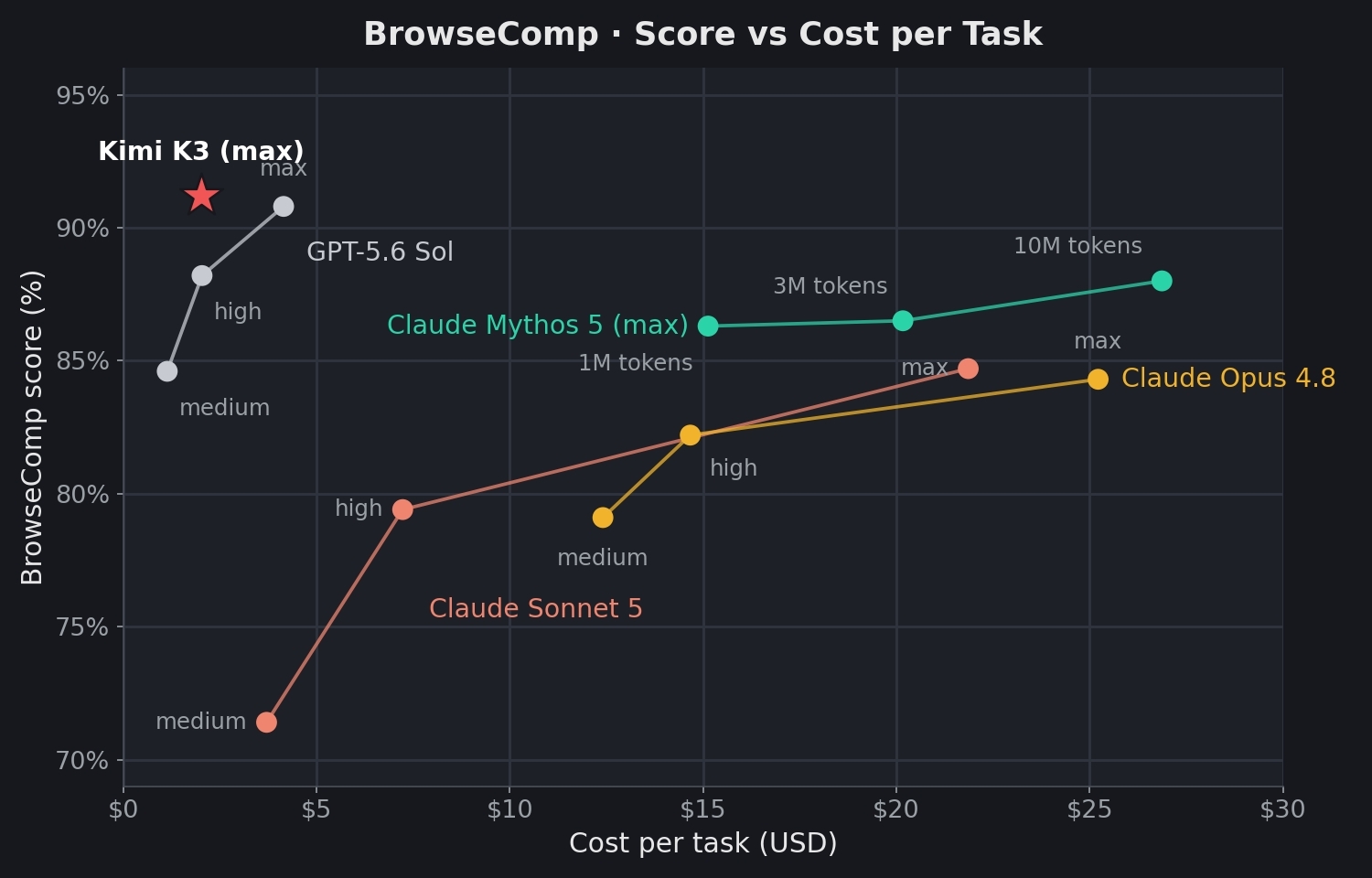
But here is where it gets wild: on BrowseComp, a brutal test of long-horizon information seeking, K3 hit 91.2 – state of the art. And on Arena.AI‘s Frontend Code Arena, it claimed #1 with 1,679 points, outpacing both Fable 5 and GPT-5.6 Sol.
BrowseComp score vs cost per task, showing Kimi K3 (max) at state-of-the-art performance with lower cost:
The model did not just compete. It won categories that matter to enterprises: spreadsheets, automation, frontend engineering, and deep research.
Coding benchmarks across DeepSWE, Terminal Bench 2.1, FrontierSWE, Program Bench, Kimi Code Bench 2.0, and SWE Marathon:


Selected wins and near-misses across Program Bench, SWE Marathon, Automation Bench, BrowseComp, OmniDocBench, Terminal Bench 2.1, and FrontierSWE:




![AINews] Kimi K3 2.8T-A50B: the largest open model ever released; Opus 4.8-class at Sonnet 5 pricing](https://i0.wp.com/kimi-web-img.moonshot.cn/img/substackcdn.com/0cd0349cdca2840fb82adf58d2075e0b2fb70fd9.png?w=1290&ssl=1)